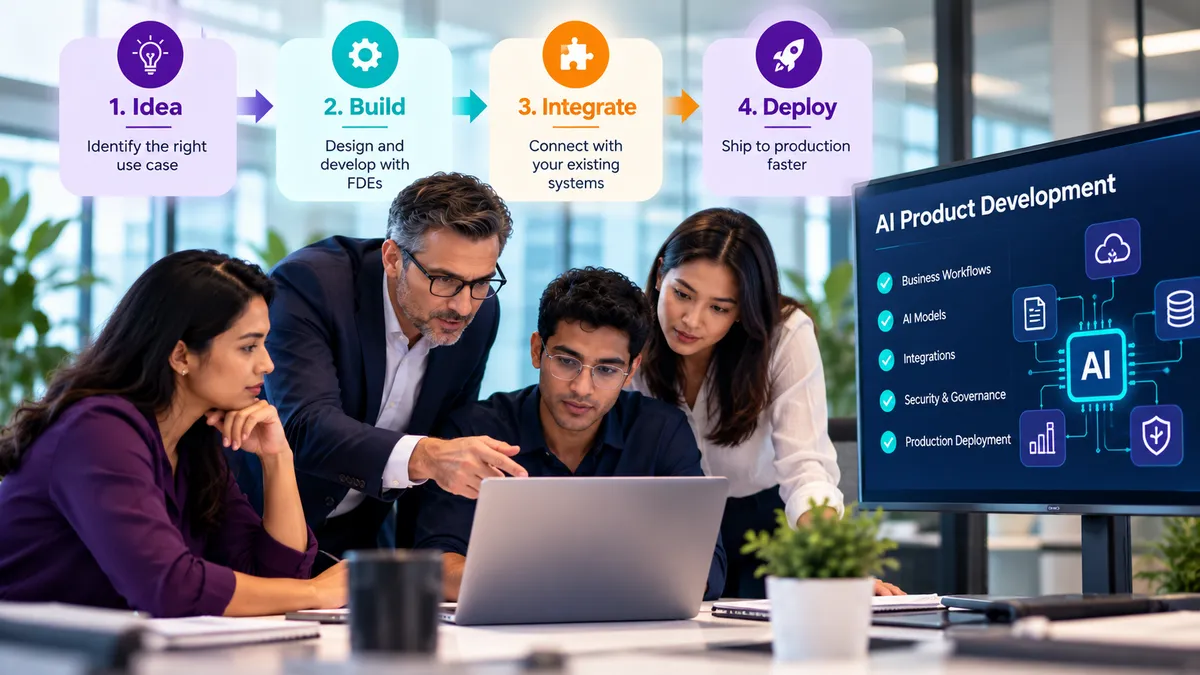
How Forward Deployed Engineers Build AI Products Faster Than Traditional Teams
How Forward Deployed Engineers Build AI Products Faster Than Traditional Teams
The AI product was supposed to launch next month.
The prototype worked. Leadership had approved the concept. The engineering team had demonstrated an AI assistant that could retrieve information, process documents, and generate useful responses.
Then the project entered its fourth planning meeting.
Illustrative composite scenario: A COO opens Slack on Monday morning and finds a familiar message: “Still waiting for IT to confirm the integration requirements.” The engineering team needs access to internal systems. Operations wants changes to the workflow. Security has questions about data handling. The project manager quietly replaces the launch date with “TBD.”
Everyone is working. Yet the product isn't moving.
This is a recurring challenge in AI product development. The technology may be ready for experimentation, but the organization isn't structured to move it into production.
Forward Deployed Engineering (FDE) offers a different approach to rapid AI development: put senior engineers close to the business problem, reduce handoffs, and make production delivery the objective from the beginning.
Quick Answer: Why Do AI Projects Fail to Deliver ROI?
AI projects often fail to deliver ROI because successful prototypes are not integrated into real business workflows. Delays arise from unclear requirements, disconnected systems, poor data quality, security reviews, and fragmented ownership. Forward Deployed Engineers address these obstacles by combining business understanding with hands-on engineering and accountability for moving a defined AI solution toward production.
The fastest way to build an AI product isn't to write code faster. It's to eliminate the distance between the business problem and the engineers solving it.
Why Does Traditional AI Product Development Take So Long?
Traditional AI product development can become slow when business decisions and engineering execution move through separate teams.
A business leader identifies an opportunity. A consultant evaluates it. A product manager prepares requirements. An architect designs the solution. Developers build the prototype. IT reviews integrations. Security evaluates deployment risks.
Each team contributes valuable expertise.
The problem is what happens between them.
A requirement that seems clear during a presentation may become ambiguous during development. An integration that appears straightforward in an architecture diagram may depend on undocumented systems. A model that performs well against sample data may struggle with actual business records.
When these discoveries occur late, the project returns to earlier stages.
The team revisits requirements, modifies the architecture, requests additional access, and schedules another review.
The resulting delay isn't necessarily caused by poor engineering. It often reflects a delivery process that separates people who understand the business from those responsible for implementation.
The hidden cost of handoffs
Every handoff creates an opportunity for context to disappear.
A business stakeholder says, “We need faster document processing.”
The technical specification becomes, “Build an AI document extraction system.”
But what does faster mean? Which documents create the bottleneck? Who reviews exceptions? Where should extracted information go?
Without those answers, developers can build exactly what was requested and still miss the operational problem.
For executives, the important distinction is between development speed and time to business value.
A prototype delivered quickly has limited value if employees cannot use it.
What Is Forward Deployed Engineering?
Forward Deployed Engineering is a delivery model in which senior engineers work directly with a client's team, data, applications, and workflows to take a defined technology use case toward production.
A Forward Deployed Engineer (FDE) combines software engineering expertise with direct business collaboration.
Rather than waiting for every requirement to move through separate organizational layers, the engineer works alongside stakeholders to understand the problem and resolve implementation constraints.
The responsibilities may include workflow discovery, architecture design, AI development, enterprise integration, testing, deployment, and knowledge transfer.
At Optywise, FDE is an outcome-oriented delivery model rather than staff augmentation. Senior engineers embed with client teams to deliver a defined production capability, not simply to provide additional development hours.
Explore Optywise's Forward Deployment Engineering approach to understand how embedded engineering connects business requirements with implementation.
How Do Forward Deployed Engineers Accelerate AI Product Development?
Forward Deployed Engineers can accelerate AI product development by reducing the delays between identifying a problem, making technical decisions, and implementing a working solution.
The advantage is not that FDE eliminates necessary engineering or governance work. It is that those activities become part of a coordinated delivery process.
1. They start with the workflow, not the technology
An FDE begins by understanding what the business needs to accomplish.
For a professional services firm, that might involve reducing manual document review, improving internal knowledge retrieval, or automating repetitive administrative tasks.
The engineer examines how the process works today, where employees encounter friction, and which outcomes matter.
This prevents teams from building sophisticated AI features that don't address the underlying business problem.
2. They make technical decisions closer to the business
An FDE works directly with the people who understand the workflow.
When requirements change or unexpected constraints appear, the engineer can discuss the implications with stakeholders and adjust the implementation plan.
This reduces the risk of lengthy cycles in which a technical team builds something, waits for business feedback, and then starts again.
3. They integrate systems during development
Enterprise AI products depend on existing technology.
A useful AI assistant may need access to document repositories, customer records, internal applications, or enterprise databases.
Forward Deployed Engineers treat these connections as core implementation requirements.
By addressing integration early, teams can discover limitations before investing heavily in an architecture that may not work in the intended environment.
4. They design for production from the beginning
A demonstration proves that a concept can work under selected conditions.
A production system must also handle realistic inputs, unexpected situations, access restrictions, and operational requirements.
An FDE considers these requirements throughout development rather than leaving them for a separate final phase.
This can reduce avoidable rework and make the path toward deployment clearer.
5. They keep ownership connected to the outcome
An AI project can involve several teams without anyone owning the complete delivery process.
FDE introduces engineering accountability around a defined use case.
That doesn't remove the responsibilities of business owners, IT, or security teams. It gives them a delivery partner working across those boundaries.
FDE vs. Traditional Development Teams: What's Different?
Forward Deployed Engineering and traditional development teams can use many of the same technologies. The distinction is how the work is organized and who is responsible for moving the use case forward.
Traditional project delivery: Business requirements may pass through product management, architecture, development, testing, and deployment teams. This structure can work well when requirements and responsibilities are clearly established.
Staff augmentation: Additional developers join an existing team, while the client generally retains responsibility for planning, prioritization, and delivery.
Forward Deployed Engineering: Senior engineers work directly with business and technical stakeholders and take responsibility for progressing a defined use case toward production.
FDE does not automatically outperform every traditional engineering team. A well-integrated internal team may already operate with similar speed and accountability.
Its advantage is most relevant when organizational handoffs, unclear requirements, and fragmented implementation ownership are slowing an otherwise viable AI initiative.
How Optywise Uses PRISM for Rapid AI Development
Optywise structures its Forward Deployed Engineering engagements around its proprietary PRISM framework: Probe, Right-size, Integrate, Secure, and Mobilise.
The framework connects business discovery with engineering execution and production delivery.
Probe: Define the right problem
Probe identifies the business workflow, users, data, systems, and constraints to establish a practical AI use case.
The objective is to understand what needs improvement before deciding what technology to build.
Right-size: Choose the appropriate architecture
Right-size selects the AI models and system architecture according to performance, latency, cost, and deployment requirements.
The most advanced model is not necessarily the most suitable choice.
Integrate: Connect AI to existing systems
Integrate connects the AI solution to enterprise applications, data sources, APIs, and operational workflows.
This is where an isolated prototype begins becoming a usable business system.
Secure: Prepare for controlled operation
Secure incorporates appropriate evaluation, access controls, guardrails, logging, and observability into the implementation.
The specific requirements depend on the organization's systems, industry, and risk profile.
Mobilise: Move the solution into use
Mobilise deploys the scoped AI workflow for practical use and transfers the knowledge needed to operate and extend it.
Optywise structures PRISM around a six-week path for a scoped first use case. Larger or more complex programs may require subsequent cycles.
The timeline is a delivery approach for appropriately scoped work, not a guarantee that every AI product or enterprise transformation can be completed in six weeks.
Learn more about Optywise's PRISM delivery framework and how it organizes the journey from business requirements to production.
What Does Faster AI Development Look Like in Practice?
Faster AI development means reducing the time between identifying a valuable workflow and making a usable solution available to employees.
Consider an illustrative example.
A consulting firm wants an internal AI assistant to retrieve information from project documents.
Under a fragmented delivery process, the business team describes the requirement, engineering builds a prototype, IT later identifies access restrictions, and operations discovers that the assistant doesn't fit the existing workflow.
The project returns to development.
Under an FDE-led approach, the engineering team begins by mapping the workflow with the business.
It identifies authoritative document sources, understands access requirements, designs the retrieval process, and establishes how users should receive and verify responses.
The system is then developed against the actual environment, with testing and operational considerations included in the implementation.
The difference is not that difficult work disappears.
The difference is that the difficult work is addressed before it becomes a late-stage surprise.
[INSERT VERIFIED PROOF POINT]
Signs Your AI Initiative Is Heading Toward the Same Wall
If your organization is struggling to move an AI product beyond the prototype, review these warning signs:
The project has a successful demo but no agreed production definition.
Business and engineering teams interpret the requirements differently.
Integration work has repeatedly been postponed.
Developers are waiting for decisions from multiple departments.
The team is measuring progress by completed features rather than operational outcomes.
Security and deployment requirements are being considered late.
Nobody owns the entire path from prototype to production.
Employees have not tested the AI within their actual workflow.
If several items remain unresolved, the bottleneck may be the delivery process rather than the engineering team's technical ability.
An approach such as Optywise's embedded engineering model can help organizations evaluate how to bring business and technical execution closer together.
Does Faster AI Development Mean Compromising Quality?
Rapid AI development should reduce unnecessary delays, not eliminate essential engineering work.
Skipping testing, ignoring data-access requirements, or deploying without clear operational ownership may make a project appear faster initially. Those shortcuts can create expensive problems later.
A more effective approach brings production considerations into the development process early.
That includes defining acceptable behaviour, evaluating realistic inputs, identifying exceptions, integrating existing systems, and establishing appropriate oversight.
The objective is to avoid discovering fundamental implementation problems after the organization has already invested in a completed prototype.
For business leaders, speed should therefore be measured by how quickly a usable capability reaches the intended workflow—not how quickly a demonstration can be assembled.
Frequently Asked Questions
What is rapid AI development?
Rapid AI development is an approach to designing, building, testing, and deploying AI solutions with shorter feedback cycles and fewer unnecessary delays. It emphasizes focused use cases, early integration, and close collaboration between business and engineering teams.
How do Forward Deployed Engineers build AI products faster?
Forward Deployed Engineers can reduce delays by working directly with stakeholders, clarifying requirements early, addressing integrations during development, and maintaining accountability for the path toward production. The actual speed advantage depends on project scope, technical constraints, and the organization's readiness.
Is Forward Deployed Engineering the same as staff augmentation?
No. Staff augmentation primarily adds development capacity to an existing team. Forward Deployed Engineering is organized around delivering a defined outcome through embedded collaboration and hands-on engineering.
Can a production AI product be built in six weeks?
A carefully scoped first AI use case may be suitable for a six-week delivery cycle, depending on data readiness, integration complexity, and operational requirements. Optywise uses a six-week PRISM approach for scoped first use cases, while larger programs may require additional cycles.
Why is integration important in AI product development?
Integration allows AI systems to interact with the information and applications required for real business workflows. Without it, even a capable model may remain disconnected from the processes where it could create value.
Faster AI Products Start With a Better Delivery Model
The biggest obstacle to AI product development is not always a shortage of engineering talent.
Sometimes the organization has the right people but the wrong delivery structure.
Requirements move through too many handoffs. Integration is addressed too late. Production ownership remains unclear. A promising prototype becomes another unfinished initiative.
Forward Deployed Engineering offers an alternative by bringing senior engineers closer to the business problem and maintaining accountability for implementation.
At Optywise, that philosophy is expressed through Embed. Ship. Transfer. The goal is to embed with the client team, ship a scoped production capability, and transfer the knowledge required for continued operation.
For founders, COOs, and operations leaders, the starting point is simple: identify one valuable workflow, define what production success means, and organize engineering around delivering that outcome.
If your AI product is stuck between prototype and production, Request a Free Consulting Call to discuss the workflow, implementation constraints, and next steps.

