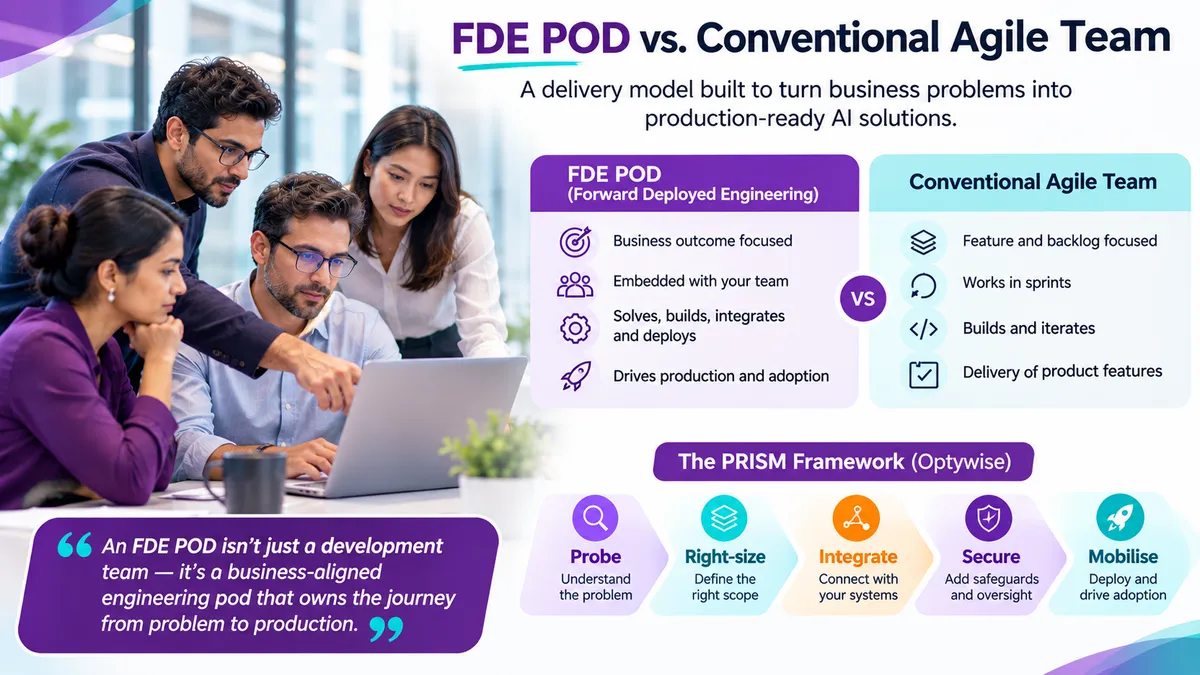
What Is an FDE POD? How Is It Different from a Conventional Agile Team?
What Is an FDE POD? How Is It Different from a Conventional Agile Team?
Your AI initiative has a roadmap, a backlog, sprint ceremonies and a team of capable engineers. Yet the business problem that triggered the project remains unresolved.
The prototype works. The product owner has approved the next sprint. Your operations team is still copying information between systems. Meanwhile, the executive sponsor is asking a question nobody wants to answer: When will this actually work in our business?
Consider this illustrative composite scenario.
A professional services firm launches an AI initiative to automate document processing. The demo impresses leadership. The engineering team starts sprinting. But three weeks later, the Slack channel is full of questions about access permissions, inconsistent documents and integration requirements. The business stakeholder who promised a launch date now wants to revisit the timeline.
Nobody is necessarily doing a bad job. The team may simply be organised around building software rather than owning the journey from business problem to operational outcome.
That is where an FDE POD enters the conversation.
Quick answer: What is an FDE POD?
An FDE POD, or Forward Deployed Engineering Pod, is a small, cross-functional team that works closely with a client to understand a business problem, build a focused solution, integrate it into the operating environment and support its adoption. Unlike a conventional Agile team organised primarily around product delivery, an FDE POD is structured around solving a defined business problem and making the solution usable in production.
Why conventional Agile teams can struggle with AI implementation
Agile is not the problem. Agile is a valuable way to organise software development around feedback, iteration and changing requirements.
The problem emerges when a team uses a software delivery model to address a business transformation challenge without clearly assigning responsibility for the operational outcome.
A conventional Agile team often works from a product backlog. The product owner prioritises requirements, developers build features, and the team reviews progress during sprint ceremonies.
This can work exceptionally well when the product, users and technical environment are reasonably understood.
AI implementation is different in one important respect: the team often discovers the real problem while trying to solve it.
A professional services firm may initially request an AI assistant to summarise client documents. During implementation, the team discovers that documents arrive through several channels, naming conventions differ between departments and critical information is missing from many files.
The original feature request was not wrong. It was incomplete.
An AI implementation partner must be prepared to work through these discoveries rather than treating them as peripheral requirements.
What does FDE POD mean in Forward Deployed Engineering?
An FDE POD is a focused engineering team that embeds closely with a client's business and technical stakeholders to deliver a defined solution in the environment where it will be used.
The word pod describes the team's collaborative structure. It is not a universally fixed staffing formula. A pod's composition depends on the business problem, required expertise and implementation scope.
A typical FDE POD may bring together:
Forward Deployed Engineers responsible for hands-on implementation.
AI or software engineers who build the necessary capabilities.
Business stakeholders who understand the workflow and operational requirements.
Client technical teams who support system access, integration and ongoing ownership.
The team does not simply receive a specification and disappear into development.
It works with the client to understand the problem, test assumptions, make implementation decisions and prepare the solution for real operational use.
For Optywise AI Solutions, Forward Deployed Engineering is a delivery model designed to bring senior engineering expertise closer to the business problems being solved.
Learn more about Optywise's Forward Deployment Engineering approach.
FDE POD vs. conventional Agile team: What is the difference?
The distinction is not that Agile teams build software while FDE PODs do not. FDE PODs can use Agile practices, including iterative development, sprint planning and frequent feedback.
The difference lies in what the team is organised to own.
Dimension | Conventional Agile team | FDE POD |
|---|---|---|
Primary orientation | Product features and backlog delivery | Defined business problem and implementation outcome |
Starting point | Product requirements or prioritised backlog | Business workflow, operational pain and constraints |
Client interaction | Often structured through product owners and stakeholders | Close, ongoing collaboration with business and technical users |
Requirements | Typically managed through backlog refinement | Actively investigated and refined during implementation |
Integration | Included in scope, but ownership varies by organisation | Central to making the solution work in the client's environment |
Success measures | Sprint goals, feature delivery, product metrics | Agreed business outcomes, production readiness and adoption |
Handover | Depends on the team and engagement | Knowledge transfer and operational ownership are explicit considerations |
This is a comparison of typical delivery orientations, not a claim that every Agile team follows the same structure.
A strong Agile team can deliver excellent business outcomes. An FDE POD is particularly useful when the problem is still evolving, implementation requires close client collaboration and the gap between development and production is the main obstacle.
Why do AI projects fail to deliver ROI even when the team is capable?
AI projects frequently struggle because technical progress and business progress are treated as the same thing.
A team may successfully build a model, automate a task or deliver a working interface. But the business still needs to determine whether the solution fits the workflow, connects to existing systems, handles exceptions and changes how employees work.
This gap is especially visible in professional services firms.
A legal, accounting, consulting or financial services team may have established review processes, client confidentiality expectations and multiple layers of approval. An AI solution that ignores these realities can create additional work rather than remove it.
An FDE POD addresses the gap by involving business users throughout implementation and making operational requirements part of engineering decisions.
The team is not just asking, "Does the feature work?"
It is asking, "Can the business actually use this solution, and what needs to happen for that to become routine?"
What changes when you use an FDE POD?
The biggest change is that implementation begins with the business workflow rather than a predetermined technology solution.
1. The team investigates before committing to a solution
An FDE POD spends time understanding how the work happens today. It identifies bottlenecks, stakeholders, data sources, existing systems and operational constraints.
This prevents the team from optimising a small task while overlooking the actual business problem.
2. The solution is deliberately scoped
A business transformation can quickly become an enormous engineering programme.
An FDE POD narrows the initial engagement to a specific use case with a clear definition of success. This makes it easier to focus effort, validate assumptions and avoid building unnecessary complexity.
A focused first implementation is not the same as a limited ambition. It creates a practical starting point for broader improvement.
3. Engineering and business feedback happen together
When engineers work closely with the people who use the process, important discoveries reach the team earlier.
A business user can explain why a particular exception matters. An engineer can evaluate the implementation implications immediately. The team can then adjust the solution based on what it learns.
This reduces the distance between business requirements and engineering decisions.
4. Integration is part of delivery
A useful AI solution must work with the systems and processes the business already depends on.
An FDE POD considers integration requirements, data access, workflow transitions and operational dependencies as part of the implementation. It does not treat production connectivity as an optional final phase.
5. The client team remains involved
FDE is not about creating permanent dependence on external engineers.
The client participates in important decisions and gains practical knowledge of the solution. Handover, operating responsibilities and future improvements should be considered throughout delivery—not postponed until the final meeting.
Signs your AI initiative is heading toward the same wall
Before hiring another AI consulting company or expanding your development team, assess the initiative you already have.
Your AI pilot works in a demo but has no clear production path.
Business users are rarely involved in engineering decisions.
Requirements keep changing because the workflow was not fully understood.
Integration problems repeatedly delay delivery.
The team measures completed features but cannot explain the business impact.
Nobody clearly owns adoption, handover or operational readiness.
Leadership keeps approving new AI experiments while existing ones remain unfinished.
If several of these statements sound familiar, your organisation may need a different delivery structure—not simply another sprint.
Optywise's PRISM implementation framework provides a structured approach to moving a scoped AI use case from discovery toward implementation and operational adoption.
How does Optywise structure an FDE POD?
Optywise uses PRISM to organise Forward Deployed Engineering around the practical work required to deliver production AI.
Each step has a distinct purpose:
Probe: Investigate the business problem, workflow, users and constraints before selecting an implementation approach.
Right-size: Define a focused use case and delivery scope that can create meaningful value without unnecessary complexity.
Integrate: Connect the solution with the relevant systems, data and business processes so it can operate in the client's environment.
Secure: Address appropriate access controls, data handling, oversight and safeguards as part of implementation.
Mobilise: Deploy the solution, support adoption and transfer the knowledge required for the client team to operate it.
PRISM is not a substitute for engineering discipline. It provides a framework for applying engineering effort to the right problem in the right sequence.
Optywise's six-week delivery target applies to a scoped first use case, not an entire enterprise transformation. Broader initiatives may require additional implementation cycles.
What does success look like after an FDE POD engagement?
The difference should be visible in how the business operates—not simply in the number of features delivered.
The original document-processing initiative, for example, should no longer be judged only by whether the AI can summarise a document.
The business should also evaluate whether the solution fits the workflow, reduces avoidable manual effort, handles defined exceptions and gives employees a clear way to review or escalate uncertain outputs.
The team should know who operates the solution, how issues are addressed and what happens when requirements change.
That is the shift from an AI experiment to an operational capability.
A useful FDE engagement does not promise that every business problem will disappear. It creates a clear path from an understood problem to a scoped, implemented solution—and gives the client a stronger foundation for what comes next.
Frequently asked questions
Is an FDE POD the same as an Agile team?
No. An FDE POD is organised around solving a defined business problem through embedded engineering and implementation. It can use Agile methods, but its focus extends beyond sprint or feature delivery to integration, production readiness and operational adoption.
Is FDE POD a standard team size or fixed methodology?
No. FDE POD is a delivery-team concept rather than a universally standardised staffing formula. Team composition and working practices depend on the client’s use case, technical environment and implementation needs.
When should a business choose an FDE POD?
Consider an FDE POD when the business problem requires close collaboration between engineering and operations, requirements are still evolving or an AI pilot is struggling to reach production. It is particularly useful when integration and implementation ownership are major challenges.
Does an FDE POD replace the client's existing Agile team?
Not necessarily. An FDE POD can work alongside the client's existing product and engineering teams. The arrangement should clarify responsibilities, collaboration and ownership rather than create competing delivery structures.
How long does an FDE POD engagement take?
The timeline depends on the use case, technical dependencies, data readiness and scope. Optywise targets six weeks for a scoped first use case through its PRISM approach; larger transformations may require additional cycles.
Build around the business problem, not just the backlog
If your AI initiative has capable engineers but continues to struggle with integration, shifting requirements or production adoption, adding more development capacity may not address the underlying issue.
You may need a team designed to work closer to the business.
Optywise AI Solutions helps professional services firms in the US and Canada move priority AI initiatives toward production through Forward Deployed Engineering. Our PRISM framework brings structure to discovery, implementation and handover while keeping the business problem at the centre.
Request a Free Consulting Call to discuss whether an FDE POD is the right delivery model for your AI initiative.

